Actividades
Juntos Podemos Curar
In February 2026, an international team of artists, technicians, and members of the Arhuaco Indigenous people embarks on an extraordinary journey into the sacred mountains of the Sierra Nevada de Santa Marta, Colombia.
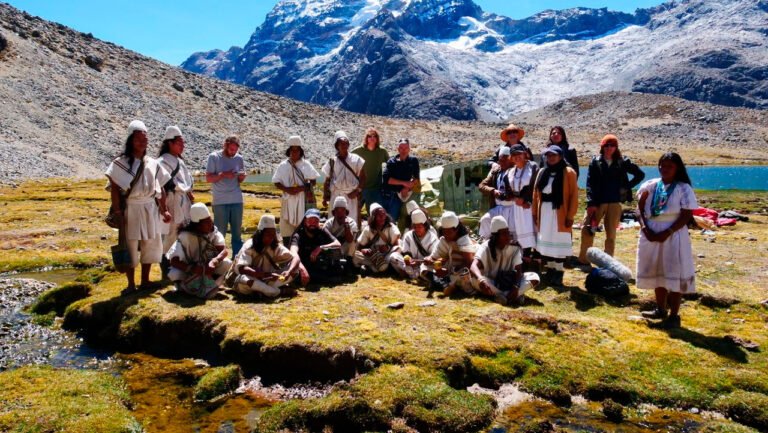
At almost 5,000 meters above sea level, the remains of a helicopter that crashed in 1974 still lie on the shore of Lake Naboba—a foreign object and a lasting disturbance within a territory of profound spiritual significance for the Arhuaco people.
With the approval and accompaniment of the Arhuaco authorities and their spiritual leaders, the Mamos, the expedition undertakes the careful recovery of the helicopter’s aluminum fragments. What begins as a technical task becomes a symbolic process of healing. Through ceremonies and a specially created protected pathway, the remains are respectfully removed from the sacred territory, restoring balance to a relationship altered between human beings and the landscape.
The documentary follows this unique journey into a remote and challenging environment and captures an encounter between Indigenous knowledge, contemporary art, and international collaboration. It shows how the traces of a past accident can become part of a process of healing, reconciliation, and connection.
In February 2027, in Santa Marta, the recovered helicopter aluminum becomes the foundation of the artwork HUSO, created by Austrian artist Emmerich Weissenberger. Together with mineralized driftwood from the Sierra Nevada, students from the University of Magdalena, together with Colectivo Yosokwi and the ArtEmbassy Art Collective, create a six-meter-high sculpture under his artistic direction.
HUSO is the spindle that spins the thread connecting all existence—the thread of Mother Naboba. The artwork represents peace, reconciliation, ecological and social justice, and creates a future space for dialogue.
Together, the documentary and the artwork form a single process: transforming a symbol of disruption into a symbol of connection, responsibility, and healing.
Photos: Nora Ruzsics

Two years of preparation led to this mission.
Gunzareiman Villafaña Torres and Amado Villafaña Chaparro, coordinators of the Arhuaco, realized it together with the traditional authorities and Mamus of the Sierra Nevada de Santa Marta.
On February 7, 2026, the international team sets out for Nabusimake: Emmerich Weissenberger (artistic concept), Nora Ruzsics, Seykugumu Garavito Torres, Camilo Mosquera Mejía and Liberman Arango (camera), Dilia Villafaña Torres (sound), as well as Gonzalo Rioseco, Hernando Barragán, Clark Shimeall and Jonathan Dabbs (technical team). The project is supported by numerous Arhuaco women and men and accompanied by Mamu Rogelio and other Mamus.In Santa Marta, the aluminum fragments undergo a second transformation: they become a social sculpture made of driftwood in the form of a lemniscate — a symbol of continuity and interconnectedness — as well as a monumental 20 × 10 meter “Mural Social.”Under the artistic direction of Emmerich Weissenberger, young Arhuaco work together with Colombian and international art students to realize the project.
Thus, “Juntos Podemos curar – We Can Heal” becomes a collective and solidarity-based act — a visible sign of responsibility, remembrance, and cultural renewal.
UrbanGreen IV
Cooperación – Artembassy – Fundación las Mercedes – Universidad Javeriana
JARDINES VOLADORES
Zepelin art installation and its staging.
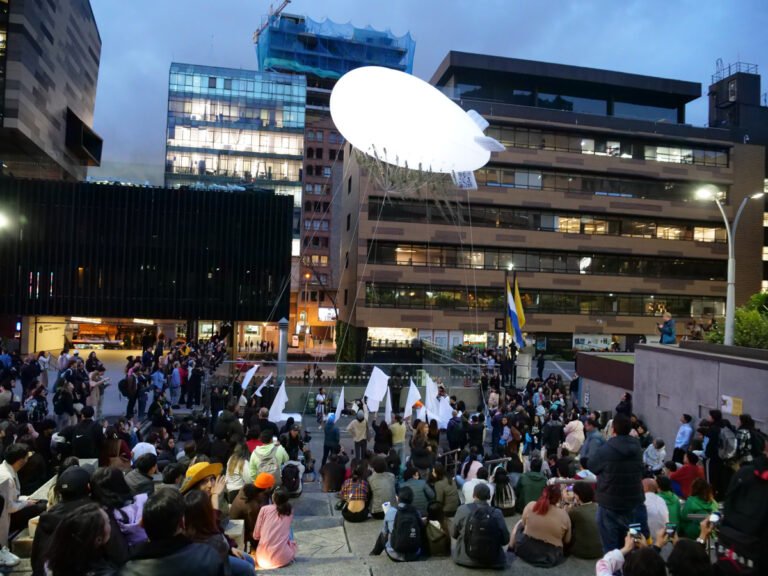
This is an art installation by ArtEmbassy and Facultad de Estudios Ambientales y Rurales as part of UrbanGreen, which is part of the Bogota Biennale BOG 25 in the main public square of the Universidad Javeriana. The 7-meter-high zeppelin filled with helium and hanging plants, a real garden of various types of Bromelia, tells of the distant relationship between humans and nature, their nature. In a positive and beautiful setting, visitors are moved and touched! The zeppelin is held by Gunza Villafaña, an Aruaca artist and filmmaker, in her white traditional dress, and the team.
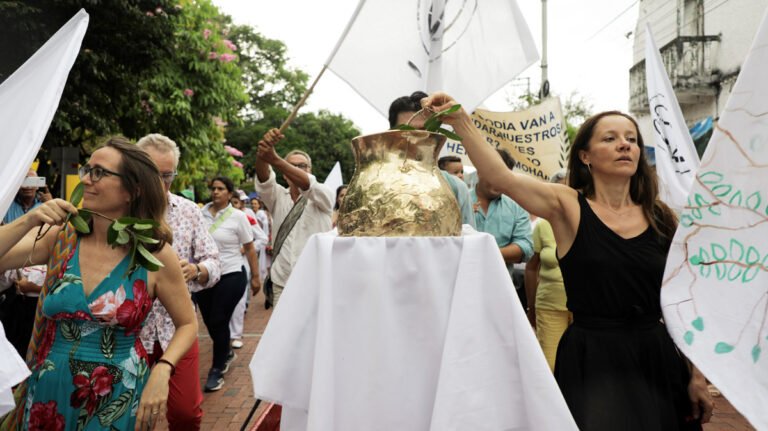
The music composition was created especially by the young composer Johannes Strigl to accompany the ascending Jardines voladores. Many white flags dance from science students and the audience moves towards the zeppelin and gives it a blessing.
The singer David Cristancho sings powerfully and longingly about the jardines and perhaps also the women in them, drawing the many spectators into our joint work with their hearts.
Jardines voladores artistic director: Emmerich Weissemberger
Production: Prof. Carlos Devia
Media Technical Coordination: Lukas Strigl
Cooperation between ArtEmbassy the Lasmercedes Foundation and Javeriana University.
Contributors:
Las Mercedes foundation:
Ronny Quimbayo ( Scientist, media )
Flor Vaca ( Administration)
Jaime Eraso (Administration)
Juan Camilo Eraso ( Administration )
De ArtEmbassy:
Nora Ruzsics ( norarufilm)
Johannes Strigl ( composer)
David Cristancho Rojas (Singer)
A happening between heaven and earth: an art show with Zeppelin, accompanied by sounds. A space forencounter, sound, and visual experience.
FESTiVAL

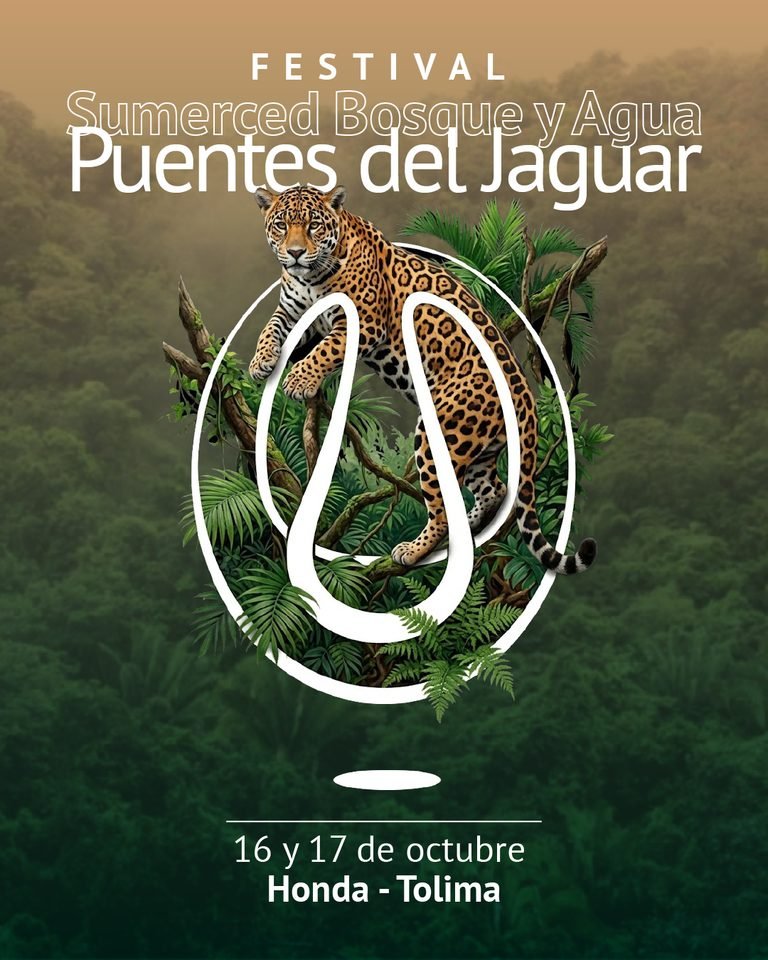
La iniciativa Las Mercedes combina la conservación ambiental, el arte y el empoderamiento comunitario para proteger el Bosque Seco Tropical, el río Magdalena y sus afluentes en el Magdalena Medio, así como zonas terrestres en la Sierra Nevada y La Guajira. Desde el año 2023, cada Día de la Tierra, 22 de abril, se celebra en Honda, Tolima, el festival anual *Sumerced Bosque y Agua*, organizado por y con el apoyo del Banco de la República. Este evento reúne a los actores del proyecto Las Mercedes, incluyendo el equipo de la Fundación, artistas, agricultores, comunidades indígenas y la población local, para intercambiar ideas y promover prácticas sostenibles. Centrado en el arte, el diálogo y la colaboración, el festival actúa como una plataforma vital para la preservación ecológica y cultural en estas importantes regiones.
Su Merced Bosque y Agua festival / April 21-22, 2023 / a film by Anfibia Casa Productora and norarufilm / HD Video / 7’17”

2024

2023